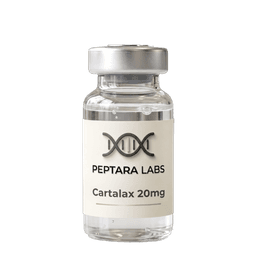
Cartalax Peptide for Sale
Published by Peptara Labs · Updated · How we research and check our pages
Three Amino Acids, Studied in Cell Cultures
Cartalax peptide from Peptara Labs (peptaralabs.io) is a 20mg research-grade vial for $50 USD, at its pre-sale price: 50% off the regular $100 until October 15, 17:00 UTC. Cartalax is a chain of three amino acids, Ala-Glu-Asp. Its published record is cell and tissue culture work, mostly from one research group. Its batch certificate of analysis is pending, so no purity figure is claimed yet. Ships October 28. Delivery windows begin after dispatch. It is sold for research use only.
Pre-sale price, 50% off, ends October 15, 17:00 UTC
Flat $35 tracked shipping20mg per vial
Ships October 28
$50 USD
Was $100
The pre-sale price applies at every quantity. No code or multi-vial pricing is added to it.
Shipping, delivery and certificate status
- Shipping
- Flat $35, tracked worldwide to supported markets
- Delivery
- Ships October 28 · After dispatch: 5 to 10 business days
- Included
- Vial · Batch certificate pending · Order support on WhatsApp
Sources: PubChem CID 87815447; Chalisova 2015, PMID 26033601; study author lists below.
Buyer facts
What do you get when you buy Cartalax from Peptara Labs?
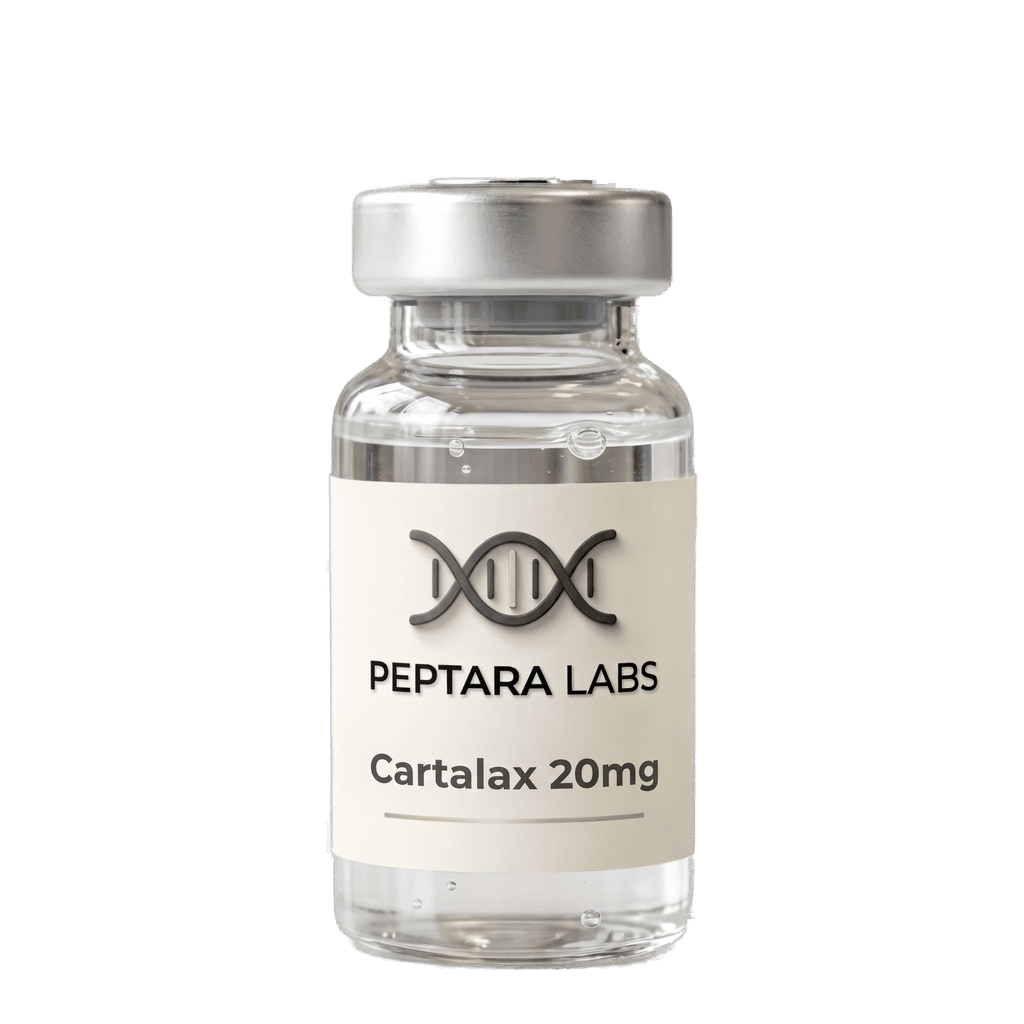
You get one sealed 20mg vial of lyophilized Cartalax, the three amino acid peptide Ala-Glu-Asp. Its batch certificate is pending, so no purity figure is claimed yet. The table reads each figure from the same catalog and pricing records used for orders.
| Detail | Peptara Labs Cartalax (20mg) | Where to check it |
|---|---|---|
| Vial | Cartalax 20mg, lyophilized powder in a sealed vial | Order panel |
| Price | $50 USD, at its pre-sale price: 50% off the regular $100 until October 15, 17:00 UTC | Live catalog price |
| Certificate | Batch certificate pending | Certificates page |
| Availability | Ships October 28. Delivery windows begin after dispatch. | Order panel |
| Delivery after dispatch | Ships October 28 · After dispatch: 5 to 10 business days | Delivery details are confirmed with your order |
| Order support | Contact our team about your order or batch certificate. | Contact Peptara Labs |
Cartalax shares its first three amino acids with Epithalon, which adds a fourth, glycine. They are different compounds. A name or similar sequence does not make their study results the same.
Share or cite this page
Sources: PubChem CID 87815447 and CID 219042.
Before you buy
What should you check before you buy Cartalax?
Check the identity evidence before relying on a purity claim. Cartalax has a molecular weight of 333.29 g/mol. A batch certificate should confirm the identity by mass as well as report the test results. That mass helps tell it apart from Epithalon, at 390.35 g/mol.
Peptara Labs has no released Cartalax batch certificate yet. This page therefore states no lot, purity result or test date. The certificates page is where the full document will appear once released. A product name and vial image cannot replace that document.
Sources: PubChem CID 87815447 and CID 219042.
The short answer
What is Cartalax?
Cartalax is a lab-made peptide made of three amino acids: alanine, glutamic acid and aspartic acid. Its sequence is Ala-Glu-Asp, or AED. Research papers also call it T-31. It comes from a Russian research program on very short peptides, and its published work is in cells and tissue grown in the lab.
The papers measure changes within those cultures. They do not show how the peptide behaves in a person, and a change in a cell marker cannot establish a result beyond the model tested.
Sources: PubChem CID 87815447; Chalisova 2015, PMID 26033601.
The science
What have lab studies measured with Cartalax?
The experiments listed here are culture studies. Researchers added AED to cells or tissue and measured growth, proteins linked to cell aging, and gene activity. These are lab measurements with different meanings, so the page keeps each model attached to its result.
Aging skin cells
In skin fibroblasts, cells that make connective tissue, AED lowered MMP-9 and raised Ki-67 and CD98hc. Those are proteins used to track cell behavior. AED also lowered caspase-driven cell death in that culture.
Kidney tissue
Kidney cultures showed changes in cell growth and aging markers. One tissue study found more Ki-67, a marker of dividing cells, and less p53. The changes were smaller than those seen with a calf kidney extract.
Stem cell genes
An aging bone marrow stem cell study tested AED with other short peptides. Across the peptides tested, IGF1 gene activity rose 3.5 to 5.6 times, and NFkB gene activity rose. The range belongs to that study, not to a result outside it.
Sources: Lin'kova 2016, PMID 27259496; Khavinson 2014, PMID 25946838; Chalisova 2015, PMID 26033601; Ashapkin 2020, PMID 32399807.
Applications
What research areas is Cartalax studied in?
Skin cell aging in culture
Researchers used aging fibroblasts to examine cell division, proteins and cell death. The work concerns cells in a dish.
Kidney cell aging in culture
Young and aged cultures were compared through cell growth and markers such as p16, p21, p53 and SIRT-6.
Stem cell gene activity
Bone marrow stem cell cultures were used to test whether short peptides changed which genes were active as the cells aged.
Cartilage cell aging
A 2023 review discussed AED in research on aging cartilage cells. It was a research topic in a review, not a demonstrated joint result.
Sources: Lin'kova 2016, PMID 27259496; Khavinson 2014, PMID 25946838; Ashapkin 2020, PMID 32399807; Myakisheva 2023, PMID 37782637.
Comparison
Cartalax vs BPC-157 and Epithalon: how do they differ?
Cartalax has three amino acids, Epithalon has four, and BPC-157 has fifteen. Their names appear in some of the same research catalogs, but their structures and study records are separate.
| Peptide | Amino acids | Formula and molecular weight | Research record |
|---|---|---|---|
| Cartalax | 3, Ala-Glu-Asp | C12H19N3O8, 333.29 g/mol | Cell and tissue cultures, mostly one research group. |
| Epithalon | 4, Ala-Glu-Asp-Gly | C14H22N4O9, 390.35 g/mol | See its separate product and research page. |
| BPC-157 | 15 | C62H98N16O22, 1,419.5 g/mol | See its separate product and research page. |
BPC-157 is a longer chain. No study in the Cartalax record listed here compared it with BPC-157. Similar research topics cannot fill that gap.
Sources: PubChem CID 87815447, CID 219042 and CID 9941957; Cartalax studies listed below.
Evidence
What does the published record show?
The table keeps the model beside each finding and includes the study that found no effect. It also separates the 2023 review from the experiments. Most of these papers share authors from the St. Petersburg research group.
| Year | Model | What was measured | What the paper reported |
|---|---|---|---|
| 2011 | Old thymus cells in culture | Cell growth, maturation and death | Only AB-9, another peptide in the study, showed an effect. T-31 did not. |
| 2014 | Young and aged kidney cells in culture | Growth; p16, p21, p53 and SIRT-6 markers | More growth, lower aging markers and more SIRT-6. A computer model suggested DNA binding. |
| 2015 | Kidney tissue from young and old rats, in culture | Ki-67 and p53 | More Ki-67 and less p53. The changes were smaller than those with a calf kidney extract. |
| 2016 | Skin fibroblasts aging in culture | Ki-67, CD98hc, MMP-9 and caspase-3 | Less MMP-9, more Ki-67 and CD98hc, and less caspase-driven cell death. |
| 2020 | Human bone marrow stem cells aging in culture | IGF1, NFkB and other gene activity | Across the peptides tested, IGF1 gene activity rose 3.5 to 5.6 times and NFkB activity rose. |
| 2023 | Review of cartilage cell research | Aging cartilage cells | Discussed the AED tripeptide as a research topic. This was a review, not a new experiment. |
Every row is cells or tissue in a dish, or a review. The ClinicalTrials.gov search checked on October 7, 2026 found no registered Cartalax trial. The 2011 null result also matters: AED did not change the measured outcomes in every cell model.
Sources: Lin'kova 2011, PMID 22238759; Khavinson 2014, PMID 25946838; Chalisova 2015, PMID 26033601; Lin'kova 2016, PMID 27259496; Ashapkin 2020, PMID 32399807; Myakisheva 2023, PMID 37782637; ClinicalTrials.gov, checked October 7, 2026.
Research timeline
How the Cartalax record was built
Research timeline
How the Cartalax record was built
Research timeline
How the Cartalax record was built
2011: thymus cells
T-31 was tested on old thymus cells in culture, with no effect found.
2014 to 2015: kidney cultures
Studies measured cell growth and aging markers in kidney cells and tissue.
2016: skin cells
A study measured growth, protein and cell death markers in aging fibroblasts.
2020: stem cell genes
Researchers measured gene activity in aging bone marrow stem cell cultures.
2023: cartilage review
A review discussed AED as a topic for research on aging cartilage cells.
Sources: Lin'kova 2011, PMID 22238759; Khavinson 2014, PMID 25946838; Chalisova 2015, PMID 26033601; Lin'kova 2016, PMID 27259496; Ashapkin 2020, PMID 32399807; Myakisheva 2023, PMID 37782637.
Your Kit
What's Included
$50 USD Was $100 USD
Flat $35 tracked shipping · Ships October 28 · Batch certificate pending · Order support on WhatsApp
Pre-sale price, 50% off, ends October 15, 17:00 UTC
Cartalax 20mg Vial
20mg per vial
Batch certificate
Batch certificate pending
Delivery
Ships October 28 · After dispatch: 5 to 10 business days
Order support
Contact our team about your order or batch certificate.
Your order includes the vial. Batch certificate pending. Delivery details are confirmed with your order. Order support is available on WhatsApp.
Your Research Order
Cartalax research vial, batch certificate status, delivery and order support.
Batch certificate
Batch certificate pending
Delivery
Ships October 28 · After dispatch: 5 to 10 business days
Order support
Contact our team about your order or batch certificate.
Research and citations
Sources
- PubChem, Cartalax. Ala-Glu-Asp, CID 87815447. PubChem CID 87815447
- Lin'kova et al., 2011. Thymocyte growth, maturation and cell death during aging in culture. Bull Exp Biol Med. PMID 22238759. DOI 10.1007/s10517-011-1298-8
- Khavinson et al., 2014. Tripeptides in aging renal cell cultures, in Russian. Adv Gerontol. PMID 25946838. PubMed PMID 25946838
- Chalisova et al., 2015. Cell renewal markers in kidney tissue cultures from young and old animals. Bull Exp Biol Med. PMID 26033601. DOI 10.1007/s10517-015-2906-9
- Lin'kova et al., 2016. Skin fibroblast functions during aging in culture. Bull Exp Biol Med. PMID 27259496. DOI 10.1007/s10517-016-3370-x
- Ashapkin et al., 2020. Gene activity in aging human mesenchymal stem cell cultures. Mol Biol Rep. PMID 32399807. DOI 10.1007/s11033-020-05506-3
- Myakisheva et al., 2023. Review of aging cartilage cells, in Russian with an English abstract. Adv Gerontol. PMID 37782637. PubMed PMID 37782637
- PubChem, Epitalon. Ala-Glu-Asp-Gly, CID 219042. PubChem CID 219042
- PubChem, BPC-157. CID 9941957. PubChem CID 9941957
- ClinicalTrials.gov. Search for Cartalax, checked October 7, 2026. Cartalax trial search
The record above concerns laboratory models and a review. It does not establish a result in people. Product identity and certificate status are separate from research findings.
Explore more
Related guides, comparisons, and compounds studied for related endpoints
Epithalon peptide
Ala-Glu-Asp-Gly has the same first three amino acids as Cartalax, plus glycine.
BPC-157 peptide
A different peptide with 15 amino acids and a separate research record.
Joint research guide
Compare the models and limits behind joint research topics.
Skin research guide
Read how peptide studies examine skin cells in the lab.
GHK-Cu peptide
A separate peptide with its own product and research page.
Vilon peptide
The Lys-Glu dipeptide from the same short peptide research program.
Testagen peptide
A four amino acid peptide with its own study record.
Batch certificates
Check which certificates have been released and which remain pending.
How to read purity evidence
Learn what a certificate can confirm about a research vial.
Peptide glossary
Plain definitions of research terms used on this page.
What are peptides?
An introduction to amino acids and peptide chains.
Questions
Buying Cartalax from Peptara Labs
Where can I buy Cartalax peptide?
Peptara Labs sells Cartalax online as a 20mg research vial, ordered from this page. Compare sellers on the batch certificate: it should confirm Ala-Glu-Asp by its molecular weight of 333.29 g/mol. The current vial price is $50 USD, at its pre-sale price: 50% off the regular $100 until October 15, 17:00 UTC. Ships October 28. Delivery windows begin after dispatch. Batch certificate pending.
What size is the Cartalax vial?
Each Cartalax vial at Peptara Labs holds 20mg of lyophilized powder. The price and multi-vial rates on this page are for that vial.
Cartalax research questions
What is Cartalax peptide?
Cartalax is a lab-made peptide of three amino acids, Ala-Glu-Asp, also called AED or T-31 in research papers. It comes from a Russian research program on very short peptides. Its published work is in cells and tissue grown in the lab.
What has Cartalax been studied for?
Lab studies added it to aging skin cells, kidney cells and stem cells, then measured cell growth, cell aging and gene activity. One 2011 study on aging thymus cells found no effect. These studies do not establish a result in people.
How is Cartalax different from BPC-157?
BPC-157 is a chain of 15 amino acids; Cartalax has 3. They come from different research programs, and no study in the record listed here has compared them.
What are the side effects of Cartalax?
Published studies listed here do not provide a side effect record in people. Missing data does not establish safety. Peptara Labs sells Cartalax for laboratory research only.
Sources: PubChem CID 87815447; Cartalax studies listed above.
Order Cartalax, 20mg vial
Order Cartalax. Ships October 28 · After dispatch: 5 to 10 business days. Order support on WhatsApp.
Order NowBatch certificate pending · Ships October 28 · Order support on WhatsApp