PE-22-28 Peptide for Sale
Published by Peptara Labs · Updated · How we research and check our pages
Seven Amino Acids, One Published Study
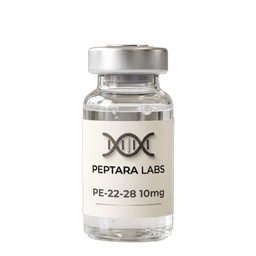
PE-22-28 peptide from Peptara Labs (peptaralabs.io) is a 10mg research-grade vial for $45 USD, at its pre-sale price: 50% off the regular $90 until October 15, 17:00 UTC. PE-22-28 is a seven amino acid piece of spadin, a natural peptide. Its published record is one 2017 lab study in cells and mice. Its batch certificate of analysis is pending, so no purity figure is claimed yet. Ships October 28. It is sold for research use only.
Pre-sale price, 50% off, ends October 15, 17:00 UTC
Pre-sale price, 50% off, ends October 15, 17:00 UTC
Flat $35 tracked shipping10mg per vial
Ships October 28
$45 USD
Was $90
The pre-sale price applies at every quantity. No code or multi-vial pricing is added to it.
Shipping, delivery and certificate status
- Shipping
- Flat $35, tracked worldwide to supported markets
- Delivery
- Ships October 28 · After dispatch: 5 to 10 business days
- Included
- Vial · Batch certificate pending · Order support on WhatsApp
Sources: Djillani 2017, PMID 28955242; catalog records for price and shipping.
Buyer facts
What do you get when you buy PE-22-28 from Peptara Labs?
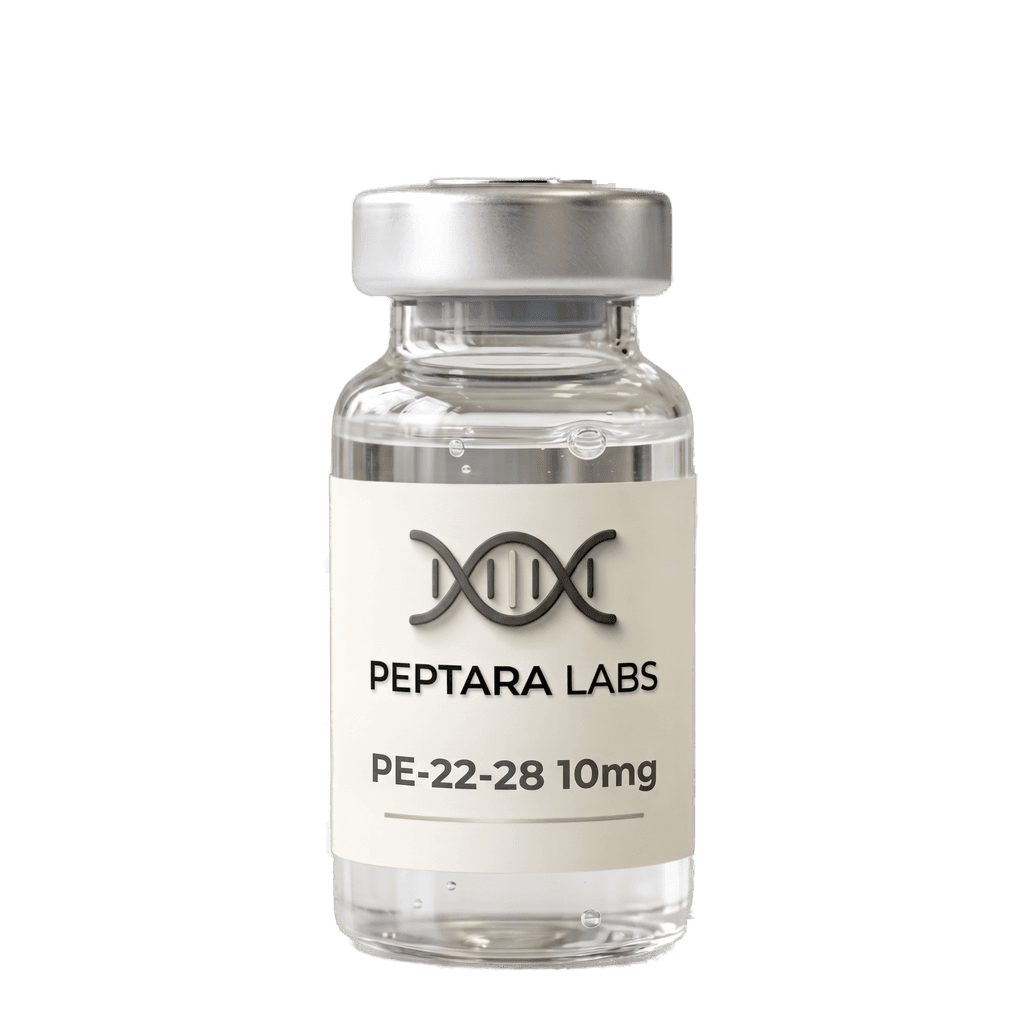
You get one sealed 10mg vial of lyophilized PE-22-28, the seven amino acid spadin fragment Gly-Val-Ser-Trp-Gly-Leu-Arg. Lyophilized means freeze-dried. Its batch certificate is pending, so no purity figure is claimed yet. The table reads price and availability from the same catalog and pricing records used for the order.
| Detail | PE-22-28 | Where to check it |
|---|---|---|
| Vial | 10mg of lyophilized PE-22-28 powder in a sealed vial | The order panel above |
| Price | $45 USD, at its pre-sale price: 50% off the regular $90 until October 15, 17:00 UTC | The order panel above |
| Availability | Ships October 28 | The order panel above |
| Certificate | Batch certificate pending | Certificates of analysis |
| Purity | No purity figure is claimed while the batch certificate is pending | Certificates of analysis |
| Sequence | Gly-Val-Ser-Trp-Gly-Leu-Arg | PubChem CID 165437303 |
| Formula and weight | C35H55N11O9, 773.9 g/mol | PubChem reference identity, not a measured batch result |
| Delivery | Ships October 28 · After dispatch: 5 to 10 business days | Delivery details are confirmed with your order |
| Status | Research use only | The study record and its limits below |
Share or cite this page
Sources: Catalog records for the order details; PubChem CID 165437303 for reference identity.
Before you buy
What should you check before you buy PE-22-28?
Match the sequence on the listing to the sequence on the certificate. PE-22-28 is Gly-Val-Ser-Trp-Gly-Leu-Arg, with a reference molecular weight of 773.9 g/mol. A detailed story about a peptide cannot replace that identity check.
- The exact chain. The 2017 paper tested shorter fragments too, and their cell results differed. Match all seven amino acids in order. Similar names do not mean the same molecule.
- Reference identity and batch identity. PubChem gives the formula C35H55N11O9 and the molecular weight 773.9 g/mol. Those describe the reference compound. A batch certificate should confirm what is in the sample by its mass.
- The certificate status. The Peptara Labs certificate is pending. This page states no measured batch purity, test date or certificate number while that document is absent.
Some listings attach targets or parent molecules from other peptides to PE-22-28. The chain is the checkable part of the listing. For the wider certificate checks, read how to verify peptide purity and the certificates page.
Sources: PubChem CID 165437303; Djillani 2017, PMID 28955242.
The short answer
What is PE-22-28?
PE-22-28 is a lab-made chain of seven amino acids: Gly-Val-Ser-Trp-Gly-Leu-Arg. It is a shortened piece of spadin, a natural peptide that blocks TREK-1, a potassium channel in nerve cells. A French lab made the fragment in 2017 while looking for a smaller version of spadin whose measured effect lasted longer in mice.
The published record under PE-22-28 is that one primary study. The paper tested cells carrying TREK-1, mouse behavior and nerve cell markers. It also compared different pieces of the parent peptide. It did not test a medicine in people.
Spadin and PE-22-28 belong to the same line of lab research, but their names refer to different lengths of chain. Later reviews discuss those findings. A review helps explain the primary paper without adding a new experiment on PE-22-28.
Sources: Djillani 2017 and 2019, PMIDs 28955242 and 30291907; PubChem CID 165437303.
The science
How does PE-22-28 work in lab studies?
In the 2017 cell tests, PE-22-28 blocked TREK-1 more tightly than spadin. TREK-1 is a channel, a small opening through a cell's outer layer that carries potassium. The researchers used human cells grown in the lab to carry that channel. There were no study participants in this cell experiment.
The same paper examined mice and nerve cells. It counted new nerve cells in the hippocampus, a brain area tied to memory and mood. It also measured PSD-95, a protein found at synapses, the connections between nerve cells. These measurements describe the test models. They do not establish an effect on a person's mood or memory.
Blocks TREK-1 in cells
In human cells grown to carry TREK-1, the fragment blocked the channel far more tightly than spadin. The channel test was separate from the mouse behavior tests.
Counts new nerve cells in mice
The paper reported more new nerve cells in the mouse hippocampus. The finding concerns mouse brain tissue and does not measure a benefit in people.
Measures a synapse protein
The paper reported more PSD-95 in cortical nerve cells. A change in one protein does not by itself describe how a whole brain works.
Sources: Djillani 2017, PMID 28955242.
Applications
What research areas is PE-22-28 studied in?
The 2017 study asked four questions: how much TREK-1 the fragments blocked, whether mouse behavior changed, whether nerve cell markers changed, and how long a change in the mouse test lasted. None of these tests measured a result in people.
TREK-1 channel research
Cells carrying TREK-1 let the researchers compare spadin with shortened pieces of its chain. The measured current showed how much channel activity each tested fragment blocked.
Mouse behavior tests
The forced swim and novelty suppressed feeding tests are used to screen antidepressant drugs. The paper measured less immobility in one test and a shorter delay in the other. Test behavior is not a diagnosis or a result for people.
New nerve cell formation
The study counted new nerve cells in the mouse hippocampus and measured PSD-95 in nerve cells. The markers describe the tested cells and tissue, without measuring human cognition.
Duration of the measured effect
The researchers compared how long spadin and modified shorter versions changed a mouse test result. The paper reported that duration and did not measure blood half-life.
Sources: Djillani 2017, PMID 28955242.
Comparison
PE-22-28 vs spadin and Selank: how do they differ?
PE-22-28 is part of spadin's chain. Selank has the same number of amino acids as PE-22-28, but a different sequence. Chain length alone does not make two peptides act on the same target or give them the same research record.
| Peptide | Amino acids and sequence | Formula and weight | TREK-1 record here |
|---|---|---|---|
| PE-22-28 | 7: Gly-Val-Ser-Trp-Gly-Leu-Arg | C35H55N11O9, 773.9 g/mol | Blocked the channel in the cell study |
| Spadin | 17: amino acids 12 to 28 of PE | C96H142N26O22, 2,012.3 g/mol | The parent peptide studied as a blocker |
| Selank | 7: Thr-Lys-Pro-Arg-Pro-Gly-Pro | C33H57N11O9, 751.9 g/mol | Not examined in the spadin study; separate research record |
PE-22-28 and Selank are both seven amino acids long, but they are different chains with different research records. The Selank page covers that peptide. The Semax page covers another peptide often listed in the same broad research area.
The spadin study did not compare PE-22-28 with Selank or Semax. The table compares their chains and the studies available for each. Findings on the longer spadin chain cannot be treated as findings on PE-22-28.
Sources: PubChem CIDs 165437303, 91826106 and 11765600; Mazella 2010, PMID 20405001; Djillani 2017, PMID 28955242.
Evidence
What does the published record show?
The name describes where this fragment sits in a larger peptide. Sortilin is a protein in cells. As it matures, it releases a piece called PE, its propeptide. Spadin is amino acids 12 to 28 of PE, a chain of 17 amino acids. PE-22-28 is amino acids 22 to 28, the last seven amino acids of spadin.
The 2017 lab did not test only the seven amino acid chain. It screened other fragments too. The table reports the TREK-1 current blocked in the paper's cell screen. The significant column records whether that test found a clear difference, using the paper's own analysis.
| Fragment of PE | TREK-1 current blocked in cells | Significant in this screen? |
|---|---|---|
| PE 12-28, spadin | 44 percent | Yes |
| PE 22-25 | 36 percent | No |
| PE 22-27 | 26 percent | No |
| PE 22-28 | 55 percent | Yes |
Removing the last amino acid gave PE 22-27, whose result was no longer significant in this screen. The tested chain therefore matters. The table does not say that every similar fragment works, nor does a percentage from this cell test describe a result in mice or people.
One lab produced this primary paper, from a CNRS group at Université Côte d'Azur in France. The mouse work used male mice. A later review discusses spadin and its shorter analogs, and a separate sortilin-derived peptide paper helps explain the parent molecule. These sources add context, and none is a study of PE-22-28 in people.
The PubMed search on October 7, 2026 returned one PE-22-28 record, the 2017 paper. The same-day ClinicalTrials.gov search listed no trial. These dated searches show the size of the named record; they do not turn missing evidence into evidence of safety.
Sources: Djillani 2017, PMID 28955242, Table 1 and PMC5601071; Djillani 2019, PMID 30291907; Daziano 2021, PMID 33737242; PubMed and ClinicalTrials.gov searches, October 7, 2026.
Measured duration
What duration did the 2017 mouse study measure?
Researchers measured a change in mouse tests, not a blood half-life. In the 2017 paper, spadin's measured effect faded beyond about 7 hours, while the longest-lasting modified PE-22-28 version lasted about 23 hours.
The 23-hour result belongs to a modified version. It is not a measured blood half-life for the unmodified chain sold on this page. The paper examined several versions, so this result cannot be assigned to every version.
Effect duration records how long a test result changes. Half-life tracks how long a measured amount takes to fall by half. The study measured effect duration, and this page states no half-life for PE-22-28.
Sources: Djillani 2017, PMID 28955242.
Research timeline
How the PE-22-28 record was built
Research timeline
How the PE-22-28 record was built
Research timeline
How the PE-22-28 record was built
Before 2010: the TREK-1 clue
Mice lacking the TREK-1 gene showed a different pattern in behavior tests. This helped frame the work on spadin.
2010: spadin and TREK-1
A paper tested the natural sortilin-derived peptide against the channel and in mouse behavior tests.
2017: the shorter fragment
A French lab tested PE-22-28 and other shortened spadin fragments in cells and mice.
2019: a research review
A review discussed spadin and its shortened analogs as TREK-1 blockers.
October 2026: the search record
The name searches found one primary paper under PE-22-28 and no registered trial.
Sources: Mazella 2010, PMID 20405001; Djillani 2017 and 2019, PMIDs 28955242 and 30291907; name searches, October 7, 2026.
Your Kit
What's Included
$45 USD Was $90 USD
Flat $35 tracked shipping · Ships October 28 · Batch certificate pending · Order support on WhatsApp
Pre-sale price, 50% off, ends October 15, 17:00 UTC
PE-22-28 10mg Vial
10mg per vial
Batch certificate
Batch certificate pending
Delivery
Ships October 28 · After dispatch: 5 to 10 business days
Order support
Contact our team about your order or batch certificate.
Your order includes the vial. Batch certificate pending. Delivery details are confirmed with your order. Order support is available on WhatsApp.
Your Research Order
PE-22-28 research vial, batch certificate status, delivery and order support.
Batch certificate
Batch certificate pending
Delivery
Ships October 28 · After dispatch: 5 to 10 business days
Order support
Contact our team about your order or batch certificate.
Research and citations
Sources
- PubChem, PE 22-28. PE 22-28, CID 165437303: amino acid sequence, formula and molecular weight. pubchem.ncbi.nlm.nih.gov/compound/165437303
- Mazella et al., 2010. Spadin, a sortilin-derived peptide, and rodent TREK-1 channels. PLoS Biol. PMID 20405001. doi.org/10.1371/journal.pbio.1000355
- Djillani et al., 2017. Shortened spadin analogs: TREK-1 inhibition, stability and mouse behavior tests. Front Pharmacol. PMID 28955242. Full text: PMC5601071. doi.org/10.3389/fphar.2017.00643
- Djillani et al., 2019. A review of TREK-1 blockers, with a focus on spadin. Pharmacol Ther. PMID 30291907. doi.org/10.1016/j.pharmthera.2018.10.003
- Daziano et al., 2021. Sortilin-derived peptides and cell signaling. Pharmacol Res. PMID 33737242. doi.org/10.1016/j.phrs.2021.105539
- PubChem, spadin. Spadin, CID 91826106: formula and molecular weight. pubchem.ncbi.nlm.nih.gov/compound/91826106
- PubChem, Selank. Selank, CID 11765600: amino acid sequence, formula and molecular weight. pubchem.ncbi.nlm.nih.gov/compound/11765600
- PubMed search, October 7, 2026. The search for PE-22-28 found one record, the 2017 study. pubmed.ncbi.nlm.nih.gov/?term=PE-22-28
- ClinicalTrials.gov search, October 7, 2026. The search for PE-22-28 found no registered trial. clinicaltrials.gov/search?term=PE-22-28
Explore more
Related guides, comparisons, and compounds studied for related endpoints
Selank
A different seven amino acid chain with its own research record.
Semax
A separate peptide and its published evidence.
Peptide cognition research
The limits of cell and animal evidence in this research area.
Adamax
A modified Semax with no published study under its own name.
Certificates of analysis
Published certificates and pending batch status.
How to verify peptide purity
What identity and purity tests establish about a batch.
Peptide glossary
Plain definitions of the terms in the study record.
What are peptides
How amino acid chains differ from each other.
How to read peptide safety evidence
Why missing data cannot establish safety.
Buying PE-22-28: FAQ
Where can I buy PE-22-28?
Peptara Labs sells PE-22-28 online as a 10mg research-grade vial, ordered from this page. Check that a seller's certificate confirms the sequence Gly-Val-Ser-Trp-Gly-Leu-Arg by its mass. The price is $45 USD, at its pre-sale price: 50% off the regular $90 until October 15, 17:00 UTC. Ships October 28. Its batch certificate is pending, so no purity figure is claimed yet.
What size is the PE-22-28 vial?
Each PE-22-28 vial at Peptara Labs holds 10mg of lyophilized powder. The price and multi-vial rates on this page are for that vial.
PE-22-28 FAQ
What is PE-22-28?
PE-22-28 is a lab-made chain of seven amino acids, Gly-Val-Ser-Trp-Gly-Leu-Arg. It is the last seven amino acids of spadin, a natural peptide that blocks a potassium channel called TREK-1. A French lab made it in 2017.
What has PE-22-28 been studied for?
One 2017 study tested it in cells and in mice. In cells it blocked TREK-1 more tightly than spadin. In mice the study measured behavior in tests used to screen antidepressant drugs and counted new nerve cells in the hippocampus. No published study has tested this peptide in people.
Is PE-22-28 an antidepressant?
No. PE-22-28 is not an approved medicine. The published work tested cells and mice. The ClinicalTrials.gov search on October 7, 2026 found no trial. Peptara Labs sells it for lab research only.
How is PE-22-28 different from Selank?
Both are seven amino acids long, but their chains differ. PE-22-28 comes from spadin and was studied as a TREK-1 blocker. Selank is a separate peptide with its own research record, covered on the Selank page.
Sources: PubChem CIDs 165437303 and 11765600; Djillani 2017, PMID 28955242; ClinicalTrials.gov search, October 7, 2026.
Order PE-22-28, 10mg vial
Order PE-22-28. Ships October 28 · After dispatch: 5 to 10 business days. Order support on WhatsApp.
Order NowBatch certificate pending · Ships October 28 · Order support on WhatsApp