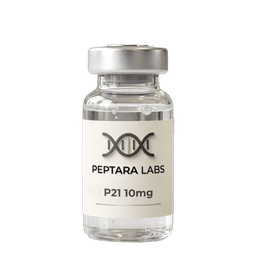
P21 Peptide for Sale
Published by Peptara Labs · Updated · How we research and check our pages
P021, a CNTF-Derived Research Compound
P21 peptide from Peptara Labs (peptaralabs.io) is a 10mg research vial of P021, a small compound built from a fragment of ciliary neurotrophic factor, priced at $105 USD, at its pre-sale price: 50% off the regular $210 until October 15, 17:00 UTC. It is not p21, the cell cycle protein that shares its name. Its batch certificate of analysis is pending, so no purity figure is claimed yet. Ships October 28. After dispatch, tracked delivery takes 5 to 10 business days. It is sold for research use only.
Pre-sale price, 50% off, ends October 15, 17:00 UTC
Flat $35 tracked shipping10mg per vial
Ships October 28
$105 USD
Was $210
The pre-sale price applies at every quantity. No code or multi-vial pricing is added to it.
Shipping, delivery and certificate status
- Shipping
- Flat $35, tracked worldwide to supported markets
- Delivery
- Ships October 28 · After dispatch: 5 to 10 business days
- Included
- Vial · Batch certificate pending · Order support on WhatsApp
Buyer facts
What do you get when you buy P21 from Peptara Labs?
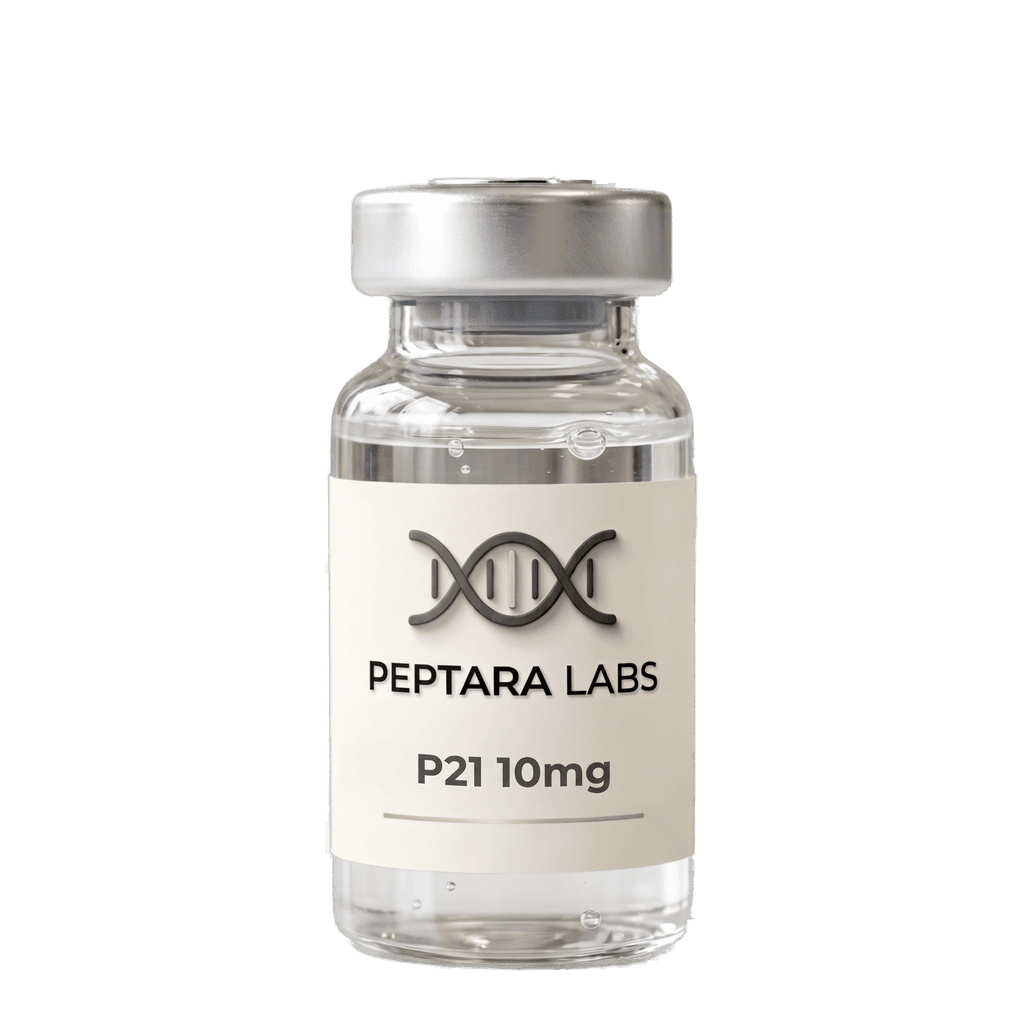
The order contains one sealed 10mg vial of P21 (P021) as lyophilized powder. Lyophilized means freeze-dried. The supplier specifies this vial as P021, Ac-DGGLAG-NH2 with an adamantane group. The batch COA is pending, so no purity figure or batch mass-spec verification is claimed.
| Detail | Peptara Labs P21 (10mg) | Where to check it |
|---|---|---|
| Vial | One sealed 10mg vial of P21 (P021), containing lyophilized, freeze-dried powder | Catalog size; supplier specifies P021 |
| Identity | P021, Ac-DGGLAG-NH2 with an adamantane group, a CNTF-derived compound | Supplier specification; batch COA pending, no batch mass-spec verification claimed |
| Also called | P021, Peptide 021 | Published research record below |
| Price | $105 USD, at its pre-sale price: 50% off the regular $210 until October 15, 17:00 UTC | Order panel |
| Availability | Ships October 28 | Dispatch begins before the delivery window |
| Certificate | Batch certificate pending. No purity figure is claimed. | Certificates of analysis |
| Shipping and delivery | Ships October 28 · After dispatch: 5 to 10 business days | Confirmed with the order |
| Status | Research use only | Catalog research-only status |
Share or cite this page
Sources: Li et al., 2010. FEBS Lett. 584(15):3359 to 3365. PMID 20600002. DOI 10.1016/j.febslet.2010.06.025.; Kazim and Iqbal, 2016. Mol Neurodegener. 11(1):50. PMID 27400746. DOI 10.1186/s13024-016-0119-y.
Before you buy
What should you check before you buy P21?
The supplier specifies this vial as P021, Ac-DGGLAG-NH2 with an adamantane group. The name p21 also appears on fragments of a different protein sold for antibody research.
- Check that the seller specifies P021, the CNTF-derived compound, rather than a fragment of the p21 protein.
- The batch certificate must confirm the identity of the material in the supplied batch.
- The certificate is pending, so no measured purity, test date or laboratory result is claimed.
Read how to verify peptide purity for the checks that apply to any seller, and see current status on the certificates page.
Sources: Li et al., 2010. FEBS Lett. 584(15):3359 to 3365. PMID 20600002. DOI 10.1016/j.febslet.2010.06.025.; UniProt P38936. CDKN1A protein identity and 164 amino acid length, read October 7, 2026.; Dong et al., 2005. Blood. PMID 15466931. DOI 10.1182/blood-2004-06-2188.
The short answer
What is P21 (P021)?
P21 is P021, a short designed compound built from an active fragment of ciliary neurotrophic factor, or CNTF. CNTF is a natural growth factor for nerve cells. The design adds an adamantane group and is described as a peptide-derived research compound.
The first paper reported it in 2010. A 2016 review describes P021 as a small compound that mimics CNTF and reports that it crosses the blood-brain barrier. That barrier controls which substances reach brain tissue.
Sources: Li et al., 2010. FEBS Lett. 584(15):3359 to 3365. PMID 20600002. DOI 10.1016/j.febslet.2010.06.025.; Kazim and Iqbal, 2016. Mol Neurodegener. 11(1):50. PMID 27400746. DOI 10.1186/s13024-016-0119-y.
The science
How P21 works in research models
BDNF in animal studies
Aged-rat work measured higher BDNF, a growth signal for nerve cells. The same result did not hold in the 2024 CDKL5 mouse model.
Tau changes in mice
An Alzheimer mouse study measured lower changes in tau, a protein linked to the model, and lower soluble amyloid beta.
New nerve cells
The first mouse paper measured the birth and maturing of new nerve cells in the hippocampus, a brain area involved in memory.
Sources: Li et al., 2010. FEBS Lett. 584(15):3359 to 3365. PMID 20600002. DOI 10.1016/j.febslet.2010.06.025.; Kazim and Iqbal, 2016. Mol Neurodegener. 11(1):50. PMID 27400746. DOI 10.1186/s13024-016-0119-y.; Bolognin et al., 2014. Neurobiol Aging. 35(9):2134 to 2146. PMID 24702821. DOI 10.1016/j.neurobiolaging.2014.02.017.; Kazim et al., 2014. Neurobiol Dis. 71:110 to 130. PMID 25046994. DOI 10.1016/j.nbd.2014.07.001.; Mottolese et al., 2024. J Neurodev Disord. 16(1):65. PMID 39592934. DOI 10.1186/s11689-024-09583-4.
Research areas
Common research areas
Aging rats
The study measured learning, memory, BDNF and markers of nerve connections in aged rats.
Alzheimer mouse models
Separate papers examined memory tests, nerve-cell loss, amyloid beta and tau changes in mice.
Down syndrome mouse model
The study examined development in young mice and memory in adult mice.
CDKL5 deficiency
A 2024 study found growth and survival changes in cells, with limited results in the mouse model.
Sources: Bolognin et al., 2014. Neurobiol Aging. 35(9):2134 to 2146. PMID 24702821. DOI 10.1016/j.neurobiolaging.2014.02.017.; Kazim et al., 2014. Neurobiol Dis. 71:110 to 130. PMID 25046994. DOI 10.1016/j.nbd.2014.07.001.; Baazaoui and Iqbal, 2017. J Alzheimers Dis. 58(1):215 to 230. PMID 28387677. DOI 10.3233/JAD-170075.; Kazim et al., 2017. Sci Rep. PMID 28368015. DOI 10.1038/srep45561.; Mottolese et al., 2024. J Neurodev Disord. 16(1):65. PMID 39592934. DOI 10.1186/s11689-024-09583-4.
Comparison
P21 vs p21: two different molecules
Search results mix these two up, so here they are side by side.
| P21 (P021), the published research compound | p21 (CDKN1A), the protein |
|---|---|
| A small designed, peptide-derived research compound | A human protein 164 amino acids long |
| Built from an active CNTF fragment with an adamantane group added | Cyclin-dependent kinase inhibitor 1, a protein that stops cell division |
| Studied in cell, mouse and rat models of nerve-cell growth and memory | Studied in cell biology and cancer research |
| Called P021 and Peptide 021 in the research record | Some lab catalogs sell pieces of this protein for antibody work |
The 2005 Blood paper examined how the tail end of the p21 protein triggered cell death. It studied the protein, not P021.
Sources: Li et al., 2010. FEBS Lett. 584(15):3359 to 3365. PMID 20600002. DOI 10.1016/j.febslet.2010.06.025.; Kazim and Iqbal, 2016. Mol Neurodegener. 11(1):50. PMID 27400746. DOI 10.1186/s13024-016-0119-y.; UniProt P38936. CDKN1A protein identity and 164 amino acid length, read October 7, 2026.; Dong et al., 2005. Blood. PMID 15466931. DOI 10.1182/blood-2004-06-2188.
Evidence
What did the P21 studies measure?
P021 studies measured learning tests and nerve-cell markers in animals. The newer CDKL5 paper also shows why a cell result cannot stand in for a result in a mouse.
| Study | Model | What was measured | Reported result |
|---|---|---|---|
| Li, 2010 | Normal adult mice | Learning, short-term and spatial memory tests, and new nerve cells in the hippocampus | Better test scores and more new and maturing nerve cells |
| Bolognin, 2014 | Aged rats | Learning, memory, BDNF and nerve-connection markers | Less decline on tests and restored nerve-connection markers |
| Kazim, 2014 | Alzheimer-model mice | Tau changes, soluble amyloid beta and memory tests | Lower protein markers and better memory test results in mice |
| Mottolese, 2024 | CDKL5-deficiency cells and mice | Nerve-cell growth, BDNF, brain structure and behavior | Growth and survival changed in cells; no higher BDNF or corrected brain structure in mice, with limited behavior changes |
The 2024 CDKL5 study found that P021 restored nerve-cell growth and survival in a dish. In mice, it did not raise BDNF or correct brain structure changes, and behavior changes were limited.
The founding 2010 and 2014 papers came from the New York State Institute for Basic Research in Developmental Disabilities in Staten Island. The 2017 Down syndrome-model paper states that its senior author holds U.S. patents on CNTF small-molecule peptide mimetics. The shared institute and declared patent interest belong alongside the results when weighing this evidence.
A ClinicalTrials.gov search for P021 on October 7, 2026 found no registered study of this compound. The 5 results were unrelated text matches.
Every result above is from cells or animals. None of it is a result for any reader.
Sources: Li et al., 2010. FEBS Lett. 584(15):3359 to 3365. PMID 20600002. DOI 10.1016/j.febslet.2010.06.025.; Bolognin et al., 2014. Neurobiol Aging. 35(9):2134 to 2146. PMID 24702821. DOI 10.1016/j.neurobiolaging.2014.02.017.; Kazim et al., 2014. Neurobiol Dis. 71:110 to 130. PMID 25046994. DOI 10.1016/j.nbd.2014.07.001.; Kazim et al., 2017. Sci Rep. PMID 28368015. DOI 10.1038/srep45561.; Mottolese et al., 2024. J Neurodev Disord. 16(1):65. PMID 39592934. DOI 10.1186/s11689-024-09583-4.; ClinicalTrials.gov, October 7, 2026. P021 search found no registered study of the compound. The 5 results were unrelated text matches.
Research timeline: How the P21 record was built
Research timeline
How the P21 record was built
2010: compound design
The first paper reported P021 and measured learning, memory and new nerve cells in adult mice.
2014: aging and Alzheimer models
Separate studies measured memory and nerve-cell markers in aged rats and Alzheimer-model mice.
2016: research review
A review described the CNTF-derived compound and its BDNF and tau findings in animals.
2017: further mouse models
Papers examined early disease changes in Alzheimer-model mice and development in Down syndrome-model mice.
2024: mixed CDKL5 results
Nerve cells in a dish showed growth and survival changes, but the mouse findings were limited.
Your Kit
What's Included
$105 USD Was $210 USD
Flat $35 tracked shipping · Ships October 28 · Batch certificate pending · Order support on WhatsApp
Pre-sale price, 50% off, ends October 15, 17:00 UTC
P21 10mg Vial
10mg per vial
Batch certificate
Batch certificate pending
Delivery
Ships October 28 · After dispatch: 5 to 10 business days
Order support
Contact our team about your order or batch certificate.
Your order includes the vial. Batch certificate pending. Delivery details are confirmed with your order. Order support is available on WhatsApp.
Your Research Order
P21 research vial, batch certificate status, delivery and order support.
Batch certificate
Batch certificate pending
Delivery
Ships October 28 · After dispatch: 5 to 10 business days
Order support
Contact our team about your order or batch certificate.
Research and citations
Peer-reviewed and regulator sources
- Li et al., 2010. FEBS Lett. 584(15):3359 to 3365. PMID 20600002. DOI 10.1016/j.febslet.2010.06.025.
- Kazim and Iqbal, 2016. Mol Neurodegener. 11(1):50. PMID 27400746. DOI 10.1186/s13024-016-0119-y.
- Bolognin et al., 2014. Neurobiol Aging. 35(9):2134 to 2146. PMID 24702821. DOI 10.1016/j.neurobiolaging.2014.02.017.
- Kazim et al., 2014. Neurobiol Dis. 71:110 to 130. PMID 25046994. DOI 10.1016/j.nbd.2014.07.001.
- Baazaoui and Iqbal, 2017. J Alzheimers Dis. 58(1):215 to 230. PMID 28387677. DOI 10.3233/JAD-170075.
- Kazim et al., 2017. Sci Rep. PMID 28368015. DOI 10.1038/srep45561.
- UniProt P38936. CDKN1A protein identity and 164 amino acid length, read October 7, 2026.
- Dong et al., 2005. Blood. PMID 15466931. DOI 10.1182/blood-2004-06-2188.
- Mottolese et al., 2024. J Neurodev Disord. 16(1):65. PMID 39592934. DOI 10.1186/s11689-024-09583-4.
- ClinicalTrials.gov, October 7, 2026. P021 search found no registered study of the compound. The 5 results were unrelated text matches.
Explore more
Related guides, comparisons, and compounds studied for related endpoints
Best peptides for cognition
How to read the different cognition research records.
Semax Selank blend
A separate two-peptide research vial.
Semax
Read the separate Semax research record.
Selank
Read the separate Selank research record.
Dihexa
Another research compound with a different evidence record.
What are peptides
The basics of peptides and research materials.
Are peptides safe
How to weigh evidence from cells and animals.
Certificates of analysis
Published batch certificates and pending status.
How to verify peptide purity
Identity and batch checks to apply to any seller.
All research products
Compare the catalog and current availability.
Questions
Buying P21: FAQ
Is P21 in stock?
P21 is on pre-order. Ships October 28. Delivery windows begin after dispatch.
What is the P21 price?
One 10mg vial is $105 USD, at its pre-sale price: 50% off the regular $210 until October 15, 17:00 UTC. The standard price is $210 once this offer ends.
Does this P21 have a certificate of analysis?
Not yet. The batch certificate is pending, so no purity figure is claimed for this vial.
P21 research FAQ
What is P21 peptide?
P21 is P021, a peptide-derived research compound built from an active fragment of ciliary neurotrophic factor, or CNTF, with an adamantane group added. CNTF is a growth factor for nerve cells. The supplier specifies this vial as P021, Ac-DGGLAG-NH2 with an adamantane group.
Which batch documents are pending?
The supplier specifies the vial as P021. The batch certificate is still pending, so no batch mass-spec verification is claimed.
Can published research be linked to this P21 vial yet?
The supplier specifies the vial as P021, so this page describes the published P021 research record. The batch certificate is still pending, and the studies do not verify this supplied batch.
What purity figure is claimed for P21?
None. The batch certificate is pending, so this page claims no measured purity, test date or laboratory result for this vial.
Is P21 the same as the p21 protein?
No. P21 here is P021, a small designed compound. The p21 protein, also called CDKN1A, is a 164 amino acid human protein that stops cell division.
What has P21 been studied for?
Memory and new nerve cells in normal and aging mice and rats, and Alzheimer's and Down syndrome mouse models.
Has P21 been tested in people?
No registered study of P021 in people was found on ClinicalTrials.gov on October 7, 2026. The 5 search results were unrelated text matches.
Has P21 been studied in autism?
Not directly. A 2024 mouse study looked at CDKL5 deficiency, a rare genetic disorder with autistic features. The mouse results were limited.
Sources: Li et al., 2010. FEBS Lett. 584(15):3359 to 3365. PMID 20600002. DOI 10.1016/j.febslet.2010.06.025.; Kazim and Iqbal, 2016. Mol Neurodegener. 11(1):50. PMID 27400746. DOI 10.1186/s13024-016-0119-y.; Bolognin et al., 2014. Neurobiol Aging. 35(9):2134 to 2146. PMID 24702821. DOI 10.1016/j.neurobiolaging.2014.02.017.; Kazim et al., 2014. Neurobiol Dis. 71:110 to 130. PMID 25046994. DOI 10.1016/j.nbd.2014.07.001.; Baazaoui and Iqbal, 2017. J Alzheimers Dis. 58(1):215 to 230. PMID 28387677. DOI 10.3233/JAD-170075.; Kazim et al., 2017. Sci Rep. PMID 28368015. DOI 10.1038/srep45561.; UniProt P38936. CDKN1A protein identity and 164 amino acid length, read October 7, 2026.; Mottolese et al., 2024. J Neurodev Disord. 16(1):65. PMID 39592934. DOI 10.1186/s11689-024-09583-4.; ClinicalTrials.gov, October 7, 2026. P021 search found no registered study of the compound. The 5 results were unrelated text matches.
Order P21, 10mg vial
Order P21. Ships October 28 · After dispatch: 5 to 10 business days. Order support on WhatsApp.
Order NowBatch certificate pending · Ships October 28 · Order support on WhatsApp